Does the Morse Generator Support Multiple Languages?
Morse code has been around for more than a century, yet it still pops up in surprising places coding projects, puzzle games, survival guides, and even social media posts. Many people who explore this system quickly ask the same question: Does the morse generator support multiple languages?
It’s a fair question. After all, the internet is multilingual. If you’re trying to convert text from Spanish, French, or even certain accented English words into Morse code, you’ll naturally wonder whether a generator can handle that.
The short answer is yes—but with a few limitations. Morse code generators typically support many languages, but the way they do it depends on the alphabet and characters used. Some tools handle this better than others, and understanding how it works can save you a lot of confusion when translating messages.
Understanding Morse Code and Language Compatibility
Morse code is not exactly a “language.” Instead, it’s a communication system made up of dots and dashes that represent letters and numbers. Each character in the alphabet gets its own pattern. Because of that structure, many modern tools can translate text from different languages into Morse code.
Most online tools work like a Morse Code translator systems that simply convert characters into Morse symbols. When you type a word into the generator, the tool reads each letter and replaces it with the corresponding Morse pattern.
So when someone asks, Does the morse generator support multiple languages?, the real answer depends on the alphabet used in the language. Languages that rely on the Latin alphabet like English, Spanish, Italian, and German usually work perfectly.
Languages that use entirely different scripts, such as Chinese, Arabic, or Japanese, may require transliteration first. That means the text gets converted into Latin letters before being turned into Morse code.


How Multilingual Morse Code Works in Practice
Imagine typing a simple greeting into a Morse generator. For example, if you search how to say hi in morse code, the word “HI” converts to:
H: ....
I: ..
Pretty straightforward.
Now try a multilingual word like “Hola.” Since Spanish uses the same Latin letters as English, the generator processes it easily:
H: ....
O: ---
L: .-..
A: .-
This is why many users discover that the answer to Does the morse generator support multiple languages is often yes, especially for languages built on the same alphabet system.
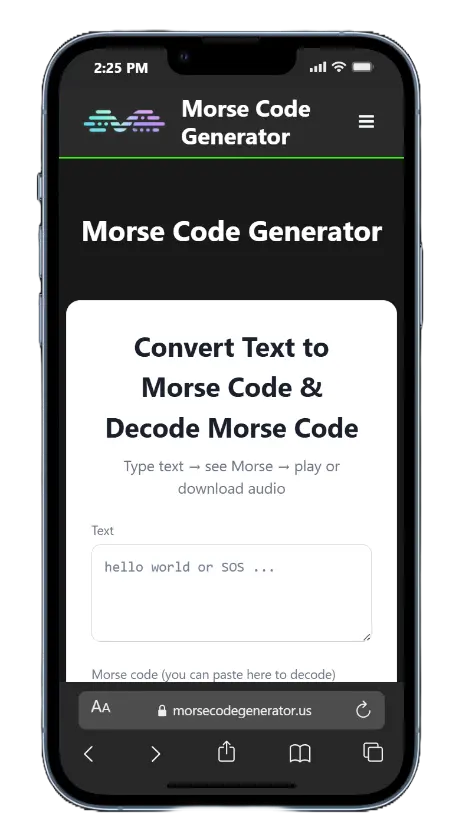
However, the moment you introduce special characters like ñ, ç, or ä, results may vary depending on the tool.
The Role of International Morse Code
A big reason multilingual support exists is something called International Morse Code. This standardized system was developed so people across different countries could communicate using the same patterns.
International Morse Code includes:
- Letters A–Z
- Numbers 0–9
- Common punctuation marks
- A few accented characters
Because of that, many generators can handle characters like:
- É
- Ü
- Ñ
Still, not every tool supports the full extended character set. Some simpler generators ignore accents and treat them as their base letters. This difference explains why two Morse tools might give slightly different outputs for the same text.
Morse Code Isn’t Limited to Text Input
Another interesting aspect of Morse communication is that it doesn’t rely only on typing. People can transmit Morse code through light, sound, or even blinking.
You may have seen guides about how to blink in morse code, where short blinks represent dots and longer blinks represent dashes.
For example:
- Short blink = dot
- Long blink = dash
- Pause = space between letters
This technique has actually been used in real-life emergencies and survival situations. The famous distress signal SOS (… — …) can be sent with a flashlight, tapping sound, or blinking.
In these cases, the language doesn’t matter as much. Once the letters are converted to Morse code, the signal works universally.
Converting Text from Different Languages into Morse Code
When working with multilingual input, most people rely on generators that automate the entire process. Tools that answer Does the morse generator support multiple languages usually function as simple converters.
If you’re curious about the conversion process itself, guides like how do i convert text to morse code explain the basic idea:
- Type your text into the generator.
- The tool breaks the sentence into characters.
- Each character gets mapped to its Morse equivalent.
- The final output appears as dots and dashes.
For example:
Text: HELLO
Morse: .... . .-.. .-.. ---
For multilingual text, the same steps apply assuming the characters exist in the Morse standard.
Advantages of Using a Multilingual Morse Code Generator
Many modern generators offer broader language support, and that brings several benefits.
1. Global Communication
People across different regions can send encoded messages without worrying about language barriers.
2. Educational Uses
Students learning Morse code often experiment with words from different languages to understand how characters translate into signals.
3. Puzzle and Game Design
Puzzle creators frequently hide messages in Morse code. Multilingual support gives them more flexibility with hidden clues.
4. Social Media Creativity
Some creators use Morse code to write secret captions or bios. Translating phrases from other languages can make these messages more unique.
Limitations You Should Know
Even though many tools claim multilingual support, there are still a few limitations.
Unsupported Scripts
Languages like:
- Chinese
- Korean
- Arabic
don’t map directly to Morse code because they use completely different writing systems.
Accent Handling
Certain tools ignore accents and convert:
- é → e
- ñ → n
Others include special Morse symbols for them.
Character Errors
Some generators simply skip characters they don’t recognize. When that happens, parts of your message might disappear from the translation.
These limitations explain why people keep asking Does the morse generator support multiple languages, especially when working with international text.
Is Morse Code Case Sensitive?
A question that often pops up while experimenting with translations is whether uppercase and lowercase letters affect Morse code output.
Many users search topics like morse code is case sensitive when they notice their typed text doesn’t change the translation.
Here’s the simple truth: Morse code is not case sensitive.
Both of these produce the same Morse pattern:
HELLO
hello
Because Morse code focuses only on characters, capitalization doesn’t matter. That makes the system much easier to use across different languages and writing styles.
Safety and Responsible Use
Morse code tools are harmless in most situations, but there are still a few practical things to keep in mind.
Avoid Miscommunication
If you’re using Morse code in a real signal like flashing lights or tapping accuracy matters. A small mistake can completely change the meaning.
Use Trusted Generators
Some websites claiming multilingual support may add ads, trackers, or unnecessary downloads. Browser-based generators are usually safer.
Practice Before Using It in Real Situations
If you plan to use Morse signals for learning, scouting activities, or emergency practice, spend time understanding the timing between dots, dashes, and spaces.
Why Morse Code Still Matters
At first glance, Morse code might seem like an outdated system from the telegraph era. Yet it continues to appear in modern technology and culture.
Radio operators still use it. Survival guides still teach it. Puzzle creators and programmers still play with it. And thanks to online generators, anyone can experiment with it instantly.
So when someone asks Does the morse generator support multiple languages, they’re really touching on something bigger the idea that a communication system invented in the 1800s can still adapt to a global, multilingual internet.
Final Thoughts
Morse code generators do support multiple languages in many cases, especially when those languages use the Latin alphabet. Spanish, French, German, and several others usually convert smoothly into Morse symbols.
Languages with different scripts may require transliteration first, and not every tool handles accented characters the same way. Still, the core concept remains simple: each letter turns into a pattern of dots and dashes. That’s why the question Does the morse generator support multiple languages keeps coming up and why the answer depends on the characters you’re using rather than the language itself.
If you’re experimenting with Morse code for fun, learning, or creative projects, multilingual generators can open up plenty of possibilities. Try converting phrases from different languages and see how they transform. You might be surprised how a system built on nothing but dots and dashes can still connect people across languages today.